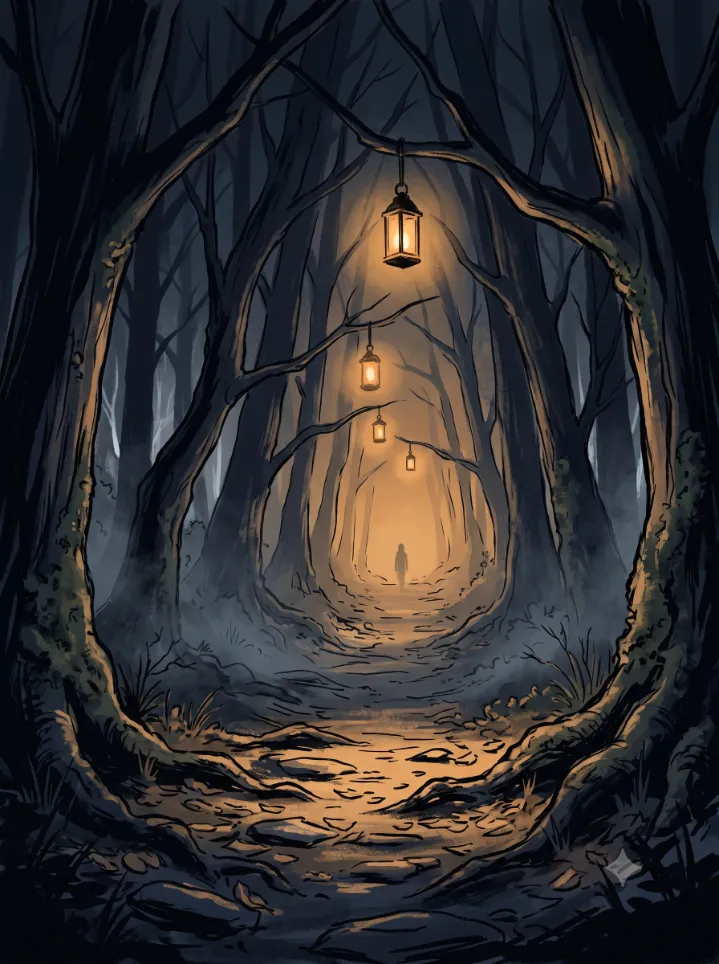
The first section almost always reads well. Things get interesting around the fourth or fifth choice – that's when people notice their story has gone flat, started circling, or drifted into a tone they never wanted. This is rarely the model's fault. It's almost always a handful of habits picked up in the first twenty minutes. Six of them are worth doing differently on purpose.
1. Start in the middle of something
The most common cause of a boring story is a premise in which nothing has happened yet. "A fantasy story in a kingdom where magic is forbidden" describes scenery. The model then has to invent what the story is actually about – and what it invents tends to be well-behaved.
"Tonight you have to arrest the man who saved your life ten years ago" is a situation. Something has already gone wrong, someone wants something, and there's a clock running. The first section can step straight into it instead of introducing a world.
A rule of thumb: if your premise contains no verb that someone is doing, it isn't one yet. How to write a premise that holds up – second person, a constraint, an open question, sparing with invented names – is covered at length in Shaping Your Own Story With AI.
2. The genre is a narrative stance, not a backdrop
You pick a genre at the start, and many people treat it as decoration – fantasy, because there should be dragons. In practice the genre mostly changes how the story is told, not what happens in it.
Crime keeps description short and builds tension out of what isn't said. Horror lets scenes sit longer and gives you the pause before the noise. Romantasy takes its time with glances, hesitation, and what happens between two sentences. Comedy speeds up and tips situations over on purpose.
That gives you a practical lever: when your story is right on paper but feels wrong – too hurried, too ponderous, too earnest – the genre is usually the first thing to change, not the premise. The same premise as crime and as horror produces two very different texts. Each genre also brings its own cover art, so the finished story ends up looking like something that exists.
3. Take the option that complicates things
Every section ends with three options. They aren't fixed in advance – they come out of the scene that was just written, which is why they're rarely "good, neutral, evil" and usually concrete: talk to her, follow her, or close the door again.
Almost everyone reaches for the cautious option at first. It's an understandable instinct and it reliably produces the weaker story. The reason isn't luck, it's craft: conflict generates text and safety doesn't. Close the door and the next section has to start something new by itself. Walk through it and the next section has something to tell you.
There's a second effect. Your choices don't just move the next scene, they set the tone of the whole story. Three cautious choices in a row give you a story about watching and suspicion. Three confrontations give you one about escalation. Either can be good – you just want to be doing it deliberately rather than by reflex.
4. Regenerate – but not at every surprise
When a section misses, you can have it rewritten: same choice, fresh attempt, without the story going back to zero. Day to day this is the single most useful tool, because it turns "the AI wrote something stupid" from a reason to quit into a minor inconvenience.
It's still worth using sparingly. Regenerating makes sense when the tone doesn't match your idea, when a character you still needed dies in passing, or when the section writes straight past the thing you actually cared about.
It makes much less sense the moment you're merely surprised. A turn you didn't plan is often exactly why this is worth doing at all – regenerate every deviation and you end up with the story you'd already imagined beforehand. One practical note: each attempt uses the same allowance as a normal section. Rewriting five times costs you five sections of story.
5. Repeat what you want kept
There's no inventory system behind the scenes and no character database. The story "knows" something because it's in the text so far, and that text is handed back to the model on every turn. In very long stories, early sections eventually slide out of that view.
That's why the lantern from section two stops mattering by section fifteen. It isn't a bug that can be fixed; it's the price of every story genuinely being written fresh instead of assembled from parts.
You can work with it, though. If an object, a character or a promise matters to you, occasionally pick the option that brings it back. What recurs stays in the model's view, and therefore in the story. What goes unmentioned for twenty sections has effectively vanished – which is also true in novels.
6. Stop while it's still good
There's no fixed number of rounds and no credits sequence that eventually rolls by itself. The story ends when it reaches a natural point – or when you stop. That's one of the few decisions nobody makes for you.
The usual disappointment doesn't come from a story being too short. It comes from one that kept going five sections past its actual ending. If a scene feels like a close, it usually is one. Ten to fifteen sections give you a story with an arc; after that a second one often starts, and it isn't the same story.
And if you like it: you can make it publicly readable behind a link and pass it on. Whoever opens it sees exactly the run your choices produced – not the story someone else would have got from the same premise.
Try it with one thing
Take a premise where something has already gone wrong, and pick the uncomfortable option every time. That's the fastest way to see what the difference actually is – right now, free, no sign-up.
Play for free