Enemies-to-lovers, forced proximity, fake dating: right now, nothing moves through book communities quite like a good Romantasy or a good Romcom premise. What carries either genre across three hundred pages isn't the plot, exactly – it's the moment the lead has to decide something. Step closer or don't. Tell the truth or keep the lie going one more day. In an AI text adventure, you make that call yourself, and the story only gets written after you do.
1. Why both genres are suddenly everywhere
Romantasy has been the dominant force in book communities for a few years now, ever since a handful of breakout series proved fantasy world-building and a real romance plot could carry each other. Romcom keeps pace alongside it, propelled by tropes that spread almost on their own on TikTok: enemies-to-lovers, fake dating, only one bed in the whole house. Both genres share something that's already a strength on the page and becomes a bigger one in an interactive story: the tension rarely comes from big external plot. It comes from what the lead says next – or doesn't.
2. The difference between reading a choice and making one
In a novel, somebody already decided how the scene ends before you get to it. The author chose the glance that lingers a second too long, the answer that comes out too fast – you experience that decision secondhand. An AI text adventure has no such decision already made. Every section, roughly 250 words, one scene rather than a summary, ends in three concrete options for what happens next, and the following section only gets written once you've clicked one of them. You're not the person the Romantasy scene happens to. You're the one who brings it about – or doesn't.
3. Romantasy: proximity neither of them chose
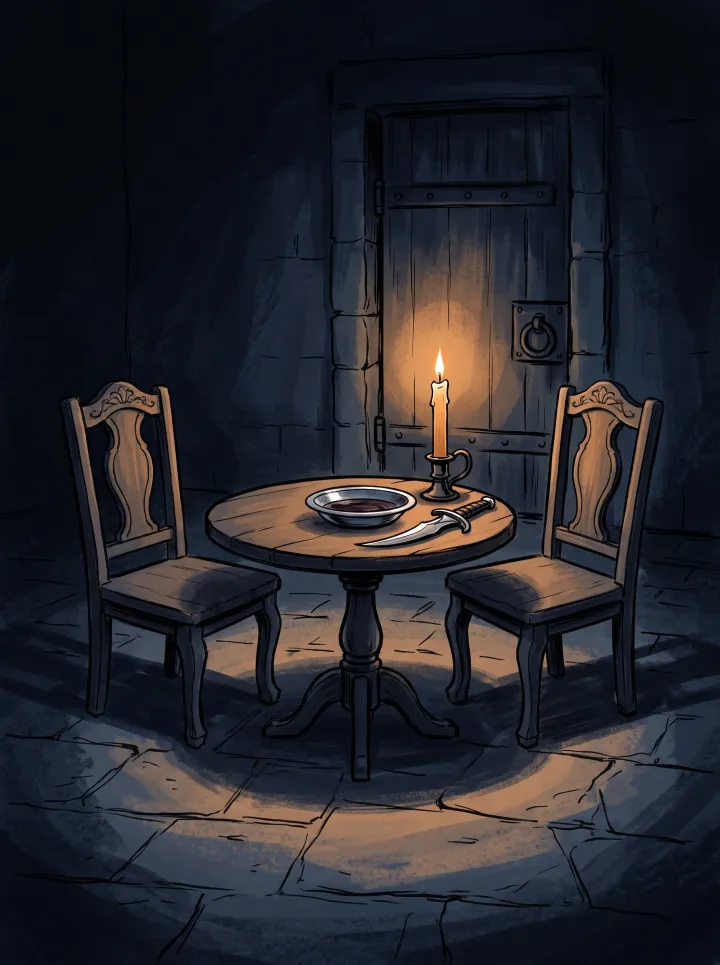
The mechanic shows up most clearly in a trope Romantasy loves: forced proximity, two characters pushed together with no way out but to deal with each other. In the example story The Blood Oath, two rivals share one room, one night, and an oath that doesn't break until moonrise – and every decision in it was one of three equally plausible options. Do you demand the truth right away, or wait to see how much she gives up on her own? In a book, that choice was made for you chapters ago. Here, you make it, and the next 250 words grow directly out of it.
4. Romcom: a fake date runs on timing, and timing is a decision
Comedy is honestly the harder genre to make interactive, because humor needs a trap, not just an open situation. Fake dating supplies that trap by itself: you told your family you're taken, and now your ex is standing next to you as your supposed partner at a wedding, three days running, seated together on purpose. The comic tone doesn't come from the premise alone – it comes from how you move through it. Do you commit to the lie, fully? Do you let it slip at the first uncomfortable glance? Do you fire back at the next comment, or go quiet and mortified instead? Each option produces a different scene, and a different flavor of funny.
5. What a session actually looks like
You type in a title and a sentence or two of premise, or pick one of the suggested starting points. The AI writes the first section from it, usually around 250 words, and ends it with three numbered options. You click one, and the next section builds directly on it. The model doesn't remember you as a person, and it doesn't learn how you like to play over time – on every turn it's handed the story's text so far and continues from there. In very long stories, older sections can slide out of that view, which occasionally produces small inconsistencies. How many sections you get in total isn't tied to a fixed number of decisions either; it depends on how much text your account has left – enough, to start, for several stories.
6. What this isn't
Honestly: this doesn't replace a good novel. AI prose of this kind is functional rather than finely crafted – it delivers a scene, not an artfully built sentence, and it has no view over two hundred pages of character arc the way an author does after rewriting her book three times. What it delivers instead is a version of the story that didn't exist before, because you helped write it with every choice you made. That's a different pleasure from reading, not a strictly better or worse one. The best way to know how it actually feels for Romantasy or Romcom is to notice that, three sections in, you want to know what you do next.
Make the first decision yourself
A title, two sentences of premise – an oath, a rival, or a fake date – and the first scene is ready in seconds. Free, no account needed.
Play for free now