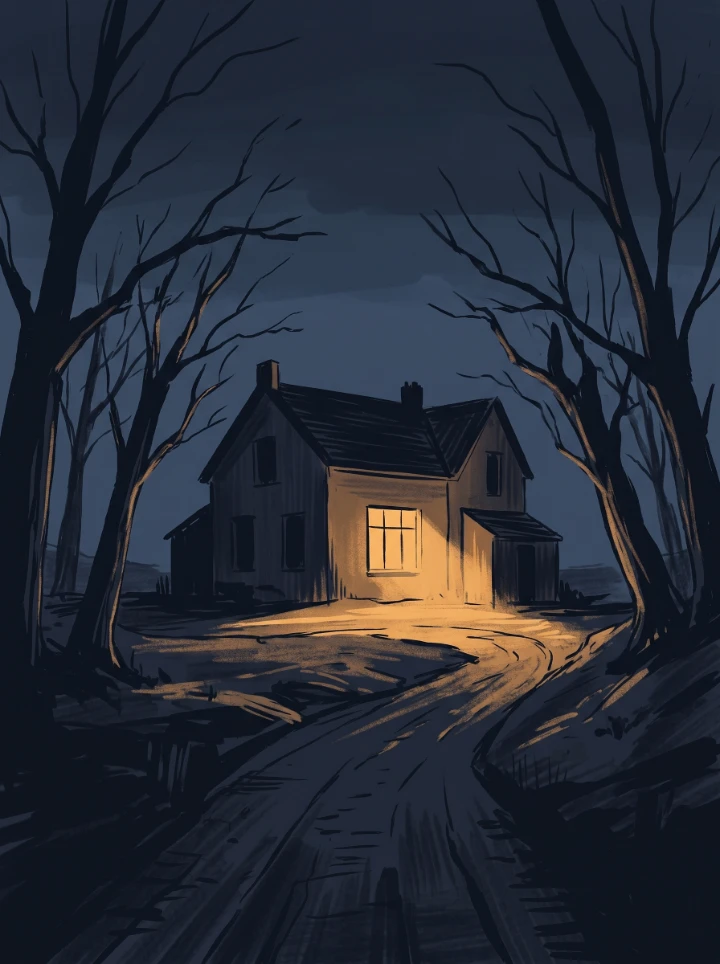
The track does not end, it only narrows. Forty minutes of spruce on both sides, no oncoming cars, and the last bar of signal died somewhere behind Rehbach.
Then the house is there.
It is not at the end of the track; it sits across it, as though the road had been built to arrive at exactly this point. Two storeys, render streaked by rain, the shutters on the upper floor closed. There is a light on downstairs. Warm light — not emergency lighting, not a motion sensor. Kitchen light.
The agent told you on the phone that nobody has lived here in nine years, and agents say a great many things. But he also told you the power was cut, and he had no reason to lie about that.
You leave the engine running. The wiper pushes needles and water aside and gives you one clear second of the front door, which is not quite shut. A gap, a hand's width. Nothing moves behind it.
Turning round is not an option. The track is too narrow, and you are not reversing forty minutes through this forest.
You switch off the engine, and in the silence afterwards you hear someone in the house running water. It runs for a while. Then it is turned off, neatly, all the way, the way you do it in a house you know.
- 1 Walk up to the open door and call out before you go in
- 2 Go round the house to the lit kitchen and look through the window You chose
- 3 Stay in the car, lock it, and wait to see who comes out
- → Or decide for yourself — your story starts here
The ground beside the house is soft and thick with spruce needles, and your footsteps make no sound at all, which you find neither good nor bad just now.
The kitchen window comes down to chest height. Inside: a table, laid for two. Two plates, two glasses, the cutlery squared off. There is a pot on the stove, and above the pot there is steam, slow and even, the steam of something that has been going half an hour.
Nobody is in the room.
A radio is playing quietly. You can hear it through the glass — not music, a voice: forecast, snow down to the valleys. The voice wishes everyone a peaceful evening.
On the table, beside the left-hand plate, lies a spiral notebook, open. The page is half filled: a column of times, short entries beside them, all in the same narrow hand. You can read the last three lines.
19:12 — nothing. 19:33 — engine, distant. 19:42 — car on the track.
Your watch says 19:44.
Behind you, down at the track, your car door shuts. You know for certain you left it open, because you left it open deliberately, to keep the interior light on.
It is dark down there now.
The kitchen door, two paces to your right, is standing ajar. It is warm behind it.
- 1 Run back to the car while you still know where it is
- 2 Go into the house through the kitchen door You chose
- 3 Stand still and wait for something else to happen
- → Or decide for yourself — your story starts here
The warmth in the kitchen is the real surprise. Not the warmth of a house that is heated — the warmth of a house that is being cooked in: fat and onions and damp air.
There is potato soup in the pot. You touch the rim with the back of your hand and pull it away again immediately.
The radio is on the dresser, an old set with a cloth front. The cable lies beside it, neatly coiled. The plug is not in the socket. The voice carries on, road conditions now.
You turn back through the notebook. The same columns, the same hand, page after page, times and short entries, whole days of them. Further back the paper foxes, and the year at the head of the page is nine years old.
One line repeats, on a great many evenings, always at about the same time:
no car.
Somebody has sat here for nine years writing down that nobody came.
Above you a floorboard gives. Once, then again, slower, as though someone had shifted their weight and taken it back.
Then the kitchen light goes out.
It does not go dark. In the hall, behind the half-open door, a light came on in the same moment, and beyond it, at the far end, another.
The house is showing you where.
- 1 Follow the light into the hall You chose
- 2 Take the notebook and leave through the kitchen door
- 3 Call up the stairs and give your name
- → Or decide for yourself — your story starts here
The hall is narrow and smells of wet felt. On the left, a row of six hooks, five of them empty.
On the sixth hangs a jacket. Dark green, hooded, the zip pull on the right-hand pocket torn off and replaced with a twist of wire.
You put that wire in yourself, two years ago, at a station, because you could not find a proper replacement.
You do not touch it.
The stairs turn as they climb. There is a small table on the half-landing, and on it a second spiral notebook, closed, with an elastic band round it. There is a date on the cover. It is today's.
Underneath it there is a name, in the same narrow hand.
It is yours.
At the top a door stands ajar, and the strip of light falling out of it is warm and steady and entirely unbothered. It smells of soup up there.
Then, in the room, somebody sets a spoon down on the rim of a plate — that short bright sound you make when you stop eating because you have heard something.
For one second it is completely quiet.
Then the chair is pushed back.
Now play it yourself
The same opening, written again from scratch - and from the first decision onwards it is your story, not this one.
Start without signing up- No account needed
- Written natively, not machine-translated
- Free to start
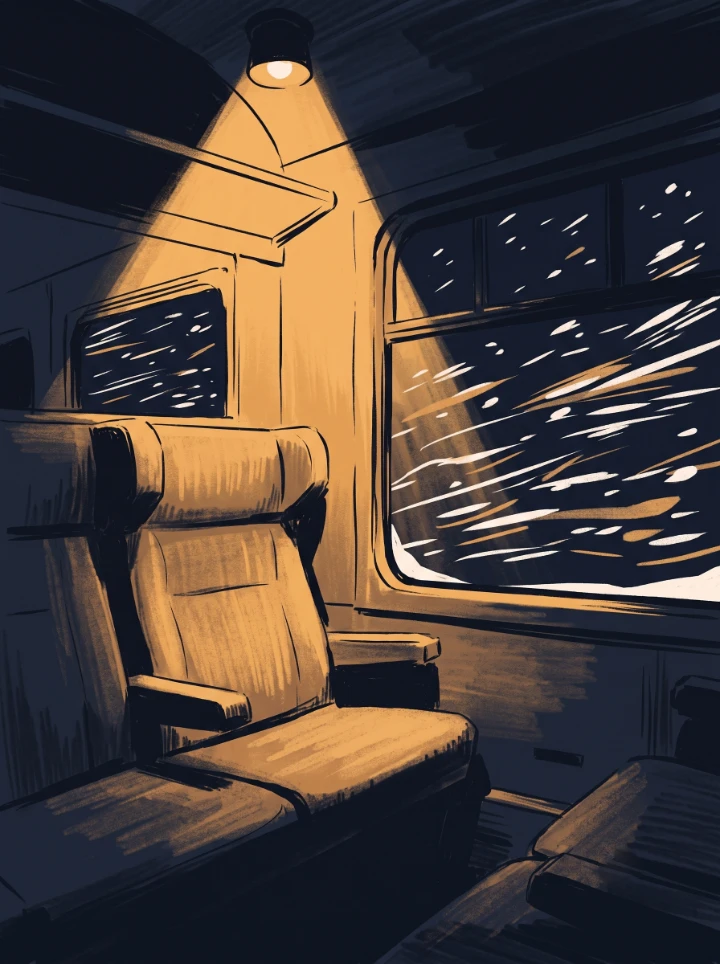 Crime
Crime
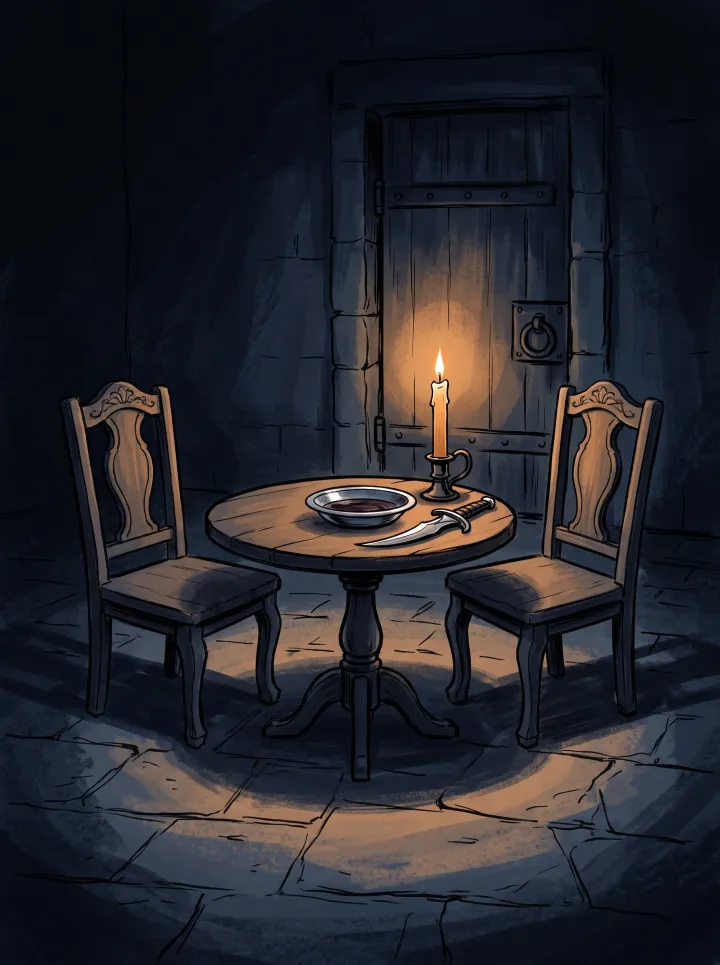 Romantasy
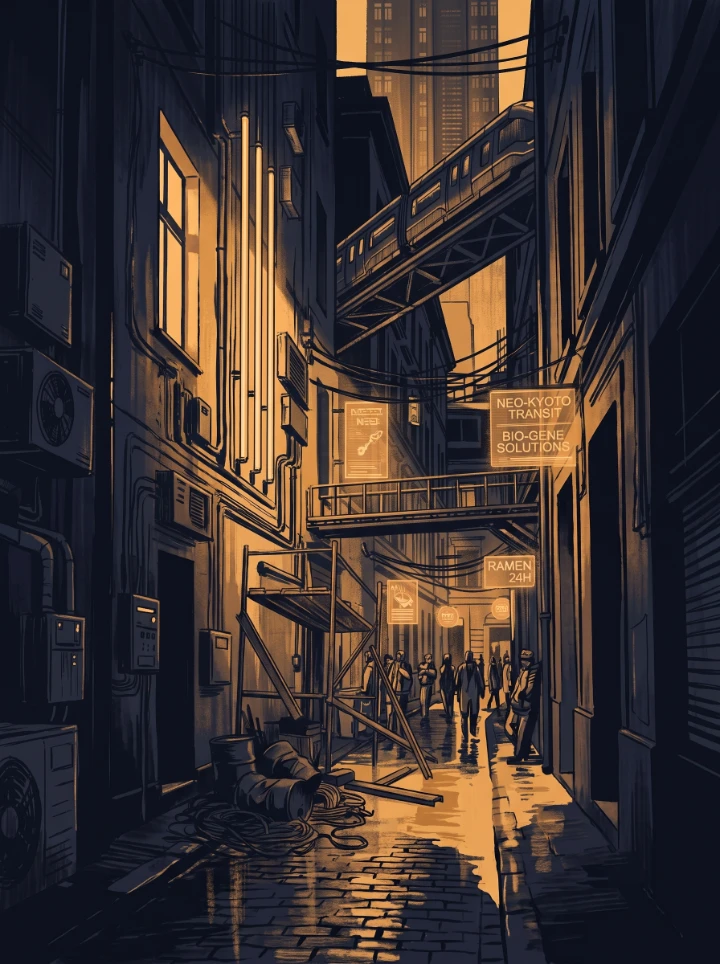 Cyberpunk
Horror where you decide when it has gone too far
That is a recording, not an extract: four sections and the three decisions between them, each shown with the two options that were not taken. Run back to the car and you never reach any of the rest of it.
Which is the difference from a horror story you read — nobody makes the stupid decision on your behalf. What follows is written from there, not before.
The House at the End of the Track gives you a situation and a reason not to turn back: a track too narrow to turn on, no signal, and a light in a kitchen that should have no power.
What to expect
- The text above is fixed - it is one recorded run, so you can read it without starting anything. In your own game it is written while you read, and no two runs are the same.
- Your choices really do branch the story - there is no single intended path to find.
- An AI writes it, not an author. It holds roughly 250 words per section, its memory of earlier sections is limited, and it occasionally drops a thread. If a section lands badly you can have it written again.
- Starting is free and needs no account. The free allowance is measured in tokens rather than turns, so how many decisions it covers depends on the story - roughly eight.