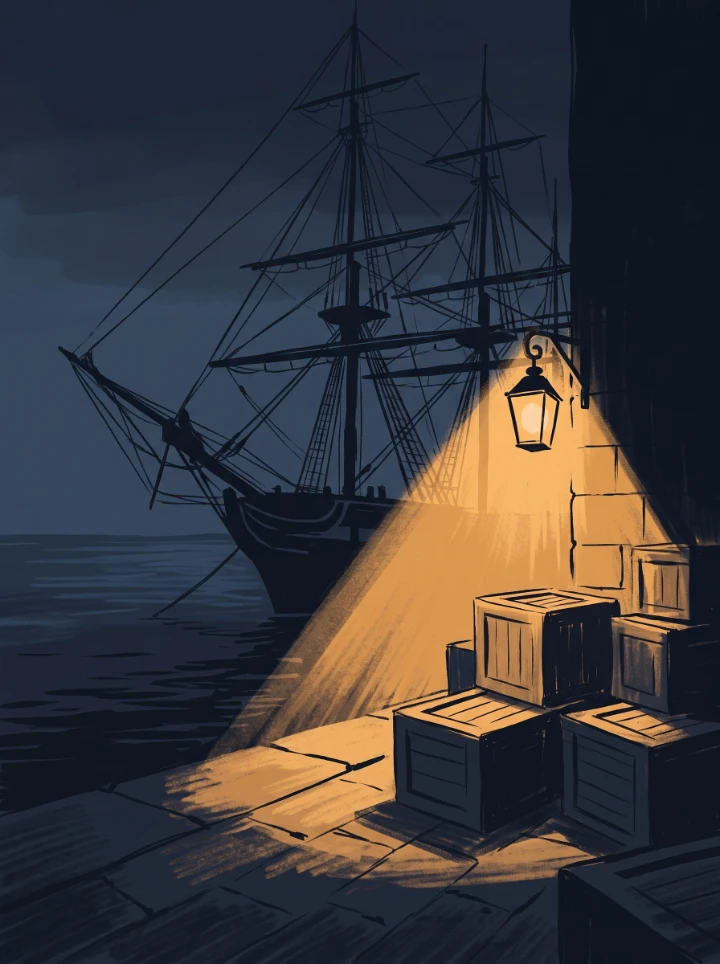
The quay smells of tar and old fish, and you're counting the crates still to load for the third time, because the number doesn't match the manifest. Forty barrels of salt, the paper the captain shoved into your hands an hour ago. You've counted thirty-two so far, and every one of them is too light.
Salt pushes back. These barrels slosh when you tip them, with a sound more like wood knocking on wood than salt.
The captain stands at the foot of the gangway driving the men on without lifting anything himself, which he never does otherwise. "Before the tide, or we sit here," he says, the fourth time in an hour, though the tide isn't due until four.
The Aurelia sits low in the water for a ship supposedly carrying salt to Marseille. Too low for forty barrels, and you've been aboard long enough to know the difference in her draft.
A man you've never seen on this voyage stands by the last crates and won't let anyone near them alone. He isn't dressed like a sailor, and his hands are too clean for quay work.
You lift the next crate at one corner, just a finger's width, to test the weight before someone takes it from you.
Too light for salt. Too heavy for wool. And from somewhere inside it, briefly, a sound that doesn't come from the water.
- 1 Ask the stranger directly what's inside the crates
- 2 Quietly open one of the crates while nobody's looking You chose
- 3 Stay silent and keep loading until the manifest can be checked
- → Or decide for yourself — your story starts here
The lid comes free quieter than you expected, because it's only loosely nailed. No salt. No cloth. Under a layer of wet sacking lie muskets, six of them, cleaned and greased, the barrels wrapped in wool so they won't rattle in transit.
You push the lid shut again immediately. Not fast enough.
A hand lands on your shoulder, not rough, but firm. The stranger who was standing by the last crates is beside you now, and there's less anger in his look than a calculation running behind it: what you're worth alive, and what it costs to keep you quiet.
"The manifest says salt," he says quietly. Not a question.
Behind him, at the far end of the quay, a lantern goes out, then a second. Two figures approach, unhurried but deliberate, nothing like dock workers doing their rounds.
"Customs," the man says, quieter still, and for the first time you hear something like fear in it. "They're checking every second ship tonight, because of Paris."
Because of Paris. The word alone tells you these muskets aren't headed for a salt port, and that the man beside you is risking more than a bad manifest.
The captain, further along, has seen the lanterns too. He doesn't turn round, but his shoulders draw in, the way a man's do when he's deciding who to sacrifice.
- 1 Stack salt barrels in front of the crate before the guard sees it You chose
- 2 Go to the captain and warn him about the customs officers
- 3 Admit to the muskets and buy the others some time
- → Or decide for yourself — your story starts here
You wrench two salt barrels off the next stack and set them in front of the open crate, so fast the rope on one cuts across your palm. The stranger helps without a word, sliding a third barrel in front just as the first lantern reaches the edge of the quay.
The customs officer is young, his coat a size too large, and he works down the manifest as if he'd written it himself. At the salt barrels he stops, taps one with his foot — the wrong one, luckily, one of the real ones — and hears the dull, correct sound of salt.
"Forty barrels," he reads aloud.
"Thirty-two loaded, eight following tomorrow," says the captain, standing beside you now, his voice steadier than it has any right to be. "The stragglers missed the weighing."
The officer writes something down without looking up. For a moment there's nothing but water slapping the Aurelia's hull.
Then he moves on, to the next crate, without looking back.
The stranger breathes out, audibly, for the first time since you've known him. "That was close," he says. Then he looks straight at you. "You didn't do that for me."
He's right, and you both know it. You did it because one wrong move would have put all of you in the dock — and because now you want to know what six muskets are doing on a salt ship bound for Marseille.
- 1 Ask who the muskets are really meant for You chose
- 2 Tell the captain the truth about the opened crate
- 3 Ask nothing more and simply sail with it
- → Or decide for yourself — your story starts here
The man glances toward the captain, who's already signalling to cast off, then back at you.
"Not for Marseille," he says. "The manifest says Marseille because that's what customs is meant to read. We sail, we turn at Port-Vendres, and whatever's in that crate goes ashore before anyone in Marseille even knows we were there."
"Who for."
He hesitates, and there's more in that hesitation than any answer would have given away. "For people who'll matter more in three weeks than you or I ever have. That's all I'll say, because if I say more, you'll know as much as I do — and that's more dangerous than knowing nothing."
The gangway is hauled in. Beneath you the Aurelia comes off the quay, slow, on the first pull of the ebb, and the harbour lights shrink behind you, one by one, until only the one lantern on the quay is left.
The captain calls down from the quarterdeck, his voice allowing no delay.
The stranger puts his hand on your shoulder once more, almost kindly this time. "You're deciding right now which side of this voyage you're on," he says. "Even if it doesn't feel like it yet."
Behind you, on the quay, one customs lantern stays where it is, longer than the others, its light held steady on the Aurelia.
Now play it yourself
The same opening, written again from scratch - and from the first decision onwards it is your story, not this one.
Start without signing up- No account needed
- Written natively, not machine-translated
- Free to start
 Crime
Crime
 Romantasy
 Horror
A historical text adventure where the manifest is lying
What you just read is not an excerpt. It is a recording: four sections of a story and the three decisions taken between them, with the two roads not taken shown alongside each — they would have pushed the same night in a different direction.
A historical text adventure doesn't run on costumes and careful manners — it runs on the gap between what's written on the paper and what's actually sitting in the hold. 1789 does the work as a year; the rest comes from a manifest that doesn't add up.
The Aurelia's Cargo gives you a harbour, a tide that won't wait, and crates that weigh more than their label says. Your version will not be this one.
What to expect
- The text above is fixed - it is one recorded run, so you can read it without starting anything. In your own game it is written while you read, and no two runs are the same.
- Your choices really do branch the story - there is no single intended path to find.
- An AI writes it, not an author. It holds roughly 250 words per section, its memory of earlier sections is limited, and it occasionally drops a thread. If a section lands badly you can have it written again.
- Starting is free and needs no account. The free allowance is measured in tokens rather than turns, so how many decisions it covers depends on the story - roughly eight.