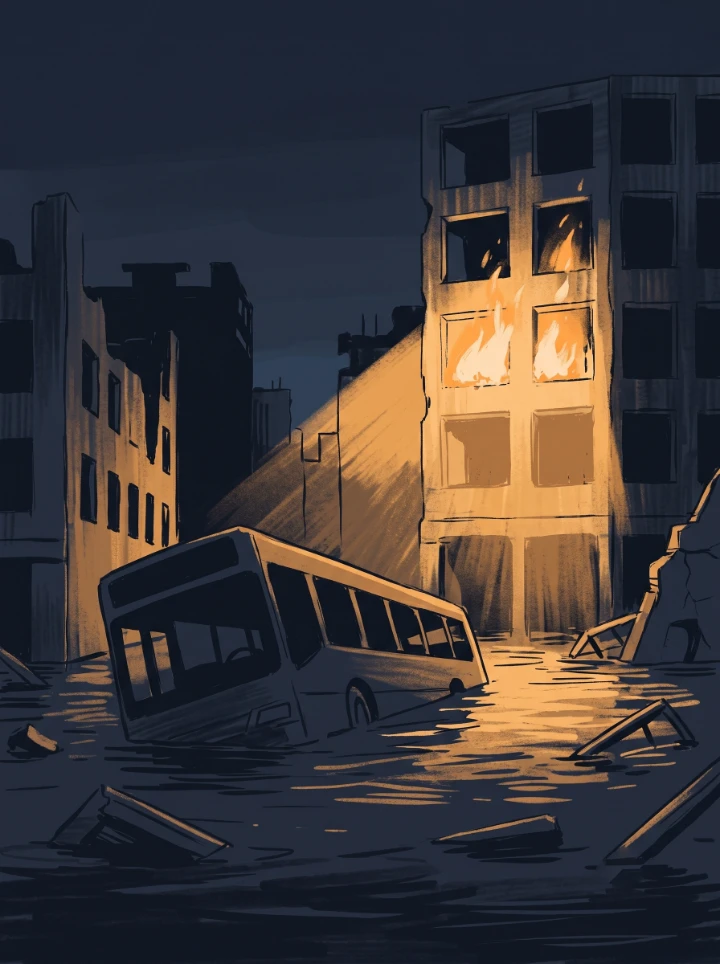
The city has been half underwater since winter, and you've been poling through what's left of it for three days, on two doors lashed together, with an oar cut from a tabletop. Your supplies ran out yesterday afternoon. One bottle of water left, and a bandage you're saving because you might need it more later.
This block used to be housing. Now it's islands of roof and upper floor, windows looking down at water that had no business being here a year ago. No lights, the whole time you've been out.
Then, on the third floor of a half-collapsed building, you see it: a window, orange, flickering. A fire, kept small, but real.
It means two things, and they weigh the same. First, somebody here has fuel to burn, which means somebody has supplies. Second, nobody keeps a fire going at this water level by accident, and people who've survived alone for months don't share it willingly.
The tide is higher tonight than usual; water is already licking the third rung of your raft, and dusk brings a current that takes anything not tied down. You have maybe an hour before paddling gets more dangerous than staying put.
You lie still in the water, thirty metres from the building, and watch a shadow cross the window once.
- 1 Call out and ask for help before the dark takes everything
- 2 Paddle quietly to the building and climb the fire escape You chose
- 3 Keep going and leave the light behind while there's time
- → Or decide for yourself — your story starts here
The fire escape is missing three rungs, and the fourth gives under your weight without quite breaking. You climb anyway, slow, one hand always on the rail, the metal cold enough to burn your fingers.
At the second-floor landing a wire runs across the stairs, barely visible, three empty cans strung along it. A warning, not a trap — whoever lives here wants to know when someone's coming, not to make sure nobody does. You lift your foot high enough to clear it, and hold your breath until the cans hang still again.
The third-floor window is boarded from inside, except for a gap barely wider than your hand. You press flat against the wall and look through.
Inside: someone, back to you, kneeling in front of a small fire built in a converted oil drum. Beside them a crate, half open. Tinned food stacked neatly, a red-cross kit still sealed, a jerrycan you recognise by its shape as drinking water. Enough to tell you this person has been planning for months, not just surviving.
They stop poking the fire and go still. Like they heard something.
Below you, far down, your raft knocks against the wall. The wind has turned.
You have maybe ten seconds before they turn around.
- 1 Knock and identify yourself before she turns around You chose
- 2 Stay perfectly still and wait to see if she notices
- 3 Retreat to the fire escape before she turns around
- → Or decide for yourself — your story starts here
The crowbar swing misses you only because you step back before you've finished saying "wait." The person — a woman, maybe sixty, sleeves pushed past her elbows — holds it between you now, but she doesn't swing again.
"Who sent you," she says. Not a question. A test.
"Nobody. I saw the fire." You keep your hands open, visible, a habit the last few months have taught you well enough. "I need a bandage, maybe some food. Then I'm gone."
She studies you a long moment. The crowbar drops an inch. No further.
"The fire's not an accident," she says finally. "I keep it high enough to see from the water. Every night for four months."
"Why, if it draws people you don't want."
"Because I want it to draw one I do." She says it without looking at you, and that's when you hear it too: a second sound outside, lower than water against the wall. An engine. Small, but real, getting closer, from the same direction you came from.
The woman goes rigid. For the first time you see she's exactly as scared as you are.
"That's not who I'm waiting for," she says quietly.
- 1 Ask her who's out there and what she's afraid of You chose
- 2 Smother the fire immediately so the boat can't see it
- 3 Go back to the fire escape and check yourself
- → Or decide for yourself — your story starts here
"Three boats came through six weeks ago," she says, eyes fixed on the door. "Call themselves a cleanup crew. They don't take what you have. They take you, if you're young enough to work, and burn the rest so nobody can say they were here."
The engine's closer now, still uneven, like someone threading a course through wreckage rather than heading straight in. You find yourself counting the seconds between sounds without meaning to, the way you've counted every noise bigger than you for months now.
"I keep the fire anyway," she says. "Because my son knows I do. He left in spring to find insulin, for his daughter, down in Block C. He said he'd come back as long as he could still see the light."
She says it like a fact, not a hope, but the hand holding the crowbar has started to shake, just slightly, and you notice for the first time how thin her wrists are under the sleeve.
The engine noise grows, then fades, then cuts out entirely, somewhere below you, too close to be chance.
The woman doesn't put the light out of her eyes, but she reaches for a second weapon, a hatchet leaning against the crate, and presses it into your hand without a word.
Outside, on the water, you can hear voices now. More than one.
Now play it yourself
The same opening, written again from scratch - and from the first decision onwards it is your story, not this one.
Start without signing up- No account needed
- Written natively, not machine-translated
- Free to start
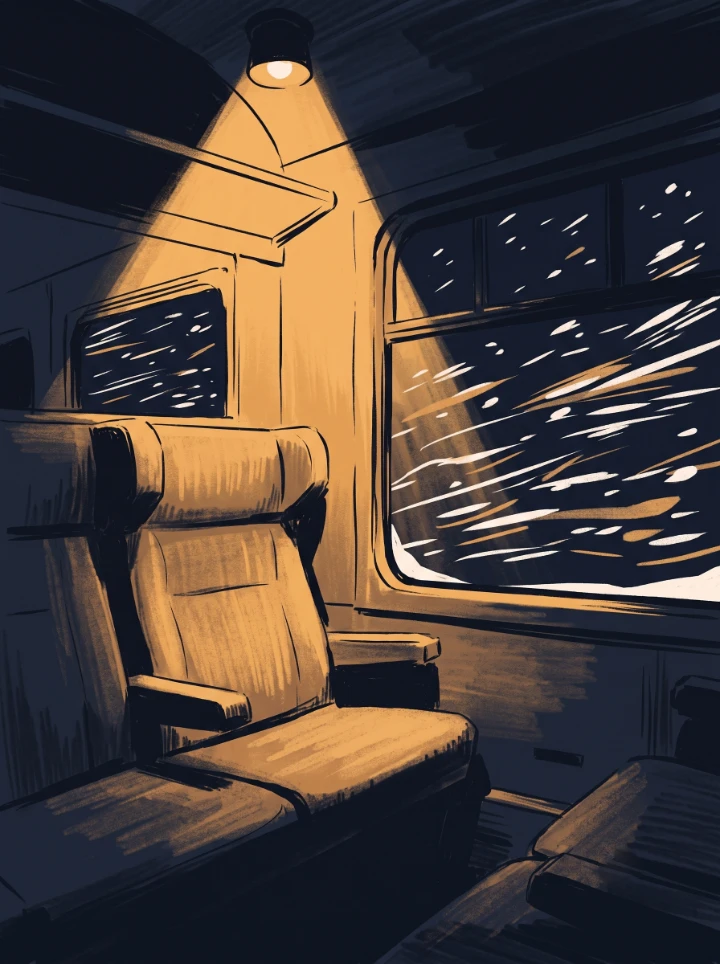 Crime
Crime
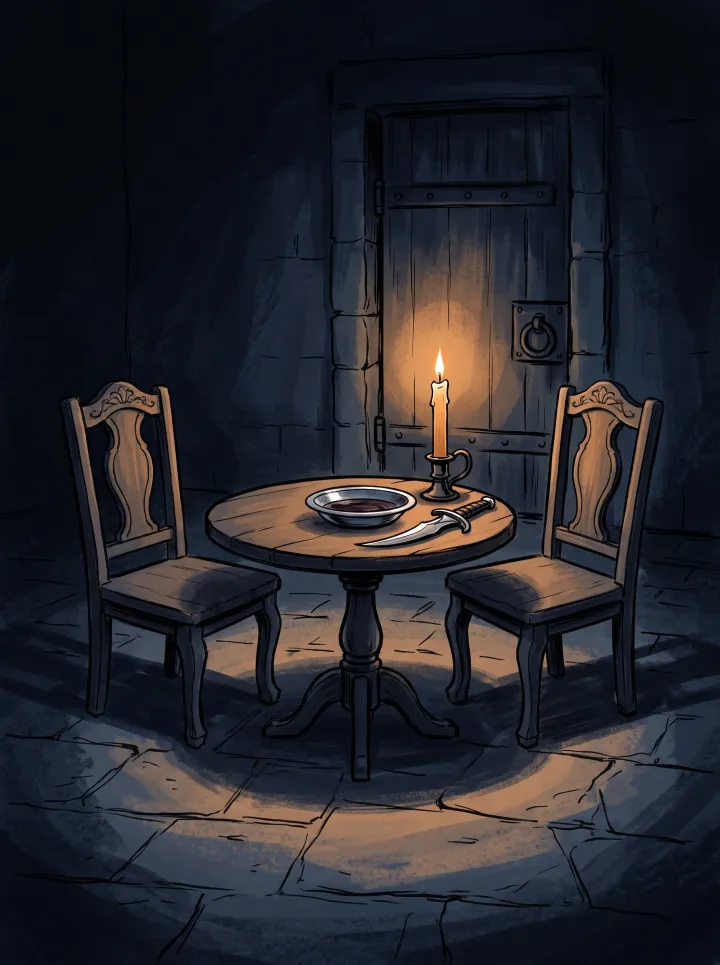 Romantasy
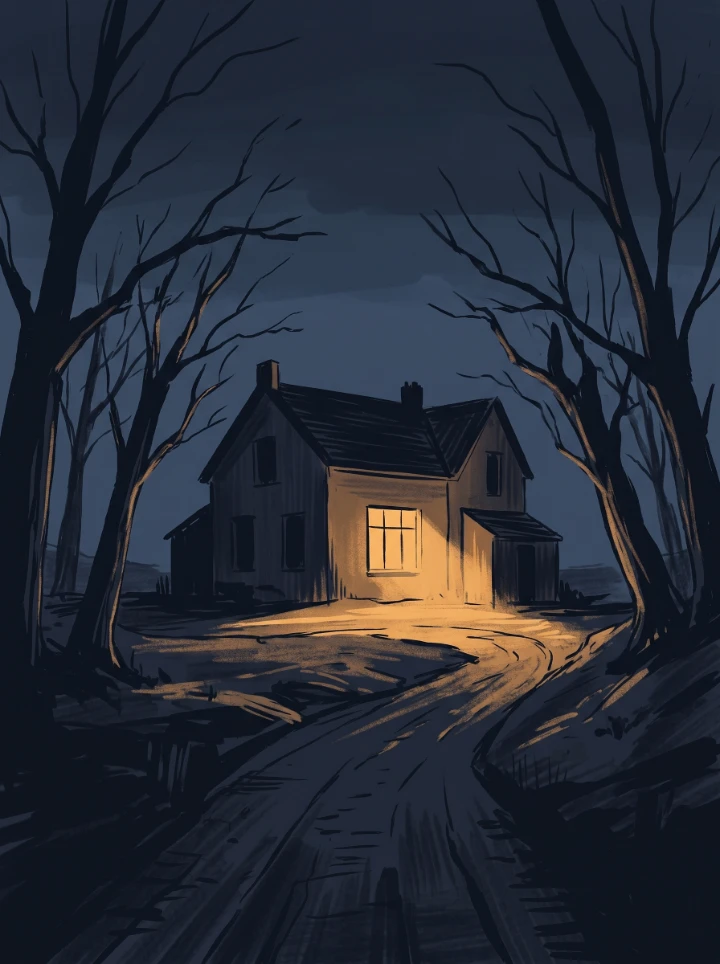 Horror
A post-apocalyptic story where every choice costs something
What you just read is not an excerpt. It is a recording: four sections of a story and the three decisions taken between them, with the two roads not taken shown alongside each — they would have led somewhere else, not somewhere better.
An interactive post-apocalyptic story runs on scarcity: there's no supply cache waiting to save you, no armour that makes you safe. Every choice — climb or call out, trust or run — costs something you don't get back.
The Fire on the Third Floor gives you a flooded city, a rising tide, and a light that means two things at once: hope and danger. Your version will not be this one.
What to expect
- The text above is fixed - it is one recorded run, so you can read it without starting anything. In your own game it is written while you read, and no two runs are the same.
- Your choices really do branch the story - there is no single intended path to find.
- An AI writes it, not an author. It holds roughly 250 words per section, its memory of earlier sections is limited, and it occasionally drops a thread. If a section lands badly you can have it written again.
- Starting is free and needs no account. The free allowance is measured in tokens rather than turns, so how many decisions it covers depends on the story - roughly eight.